

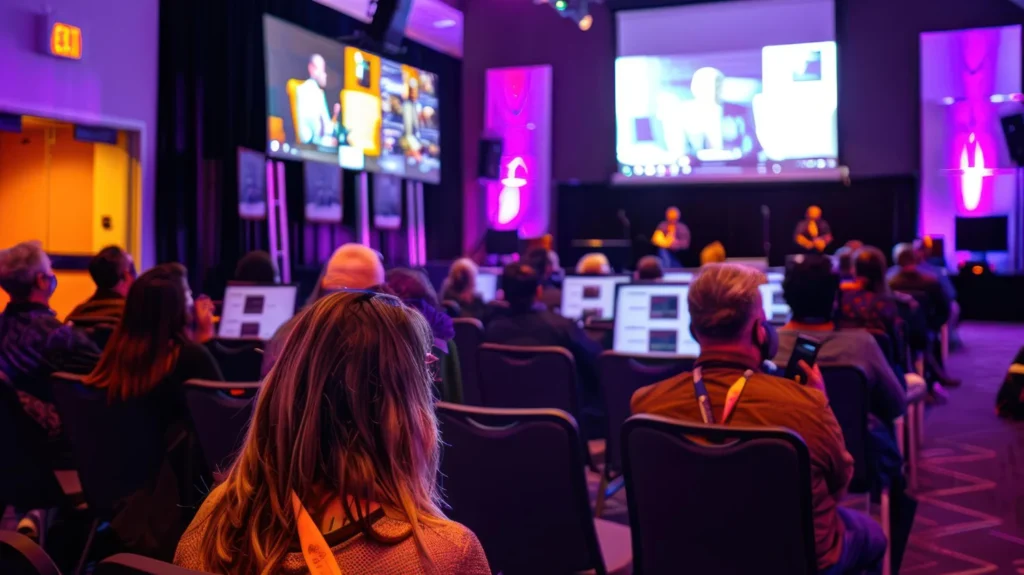
The hybrid corporate event has secured its place in organizations’ calendars. More than a post-pandemic adaptation, it has become a strategic choice for companies that need to engage geographically dispersed audiences without sacrificing the value of a high-quality in-person experience.
The challenge, however, is real. Designing an event that works effectively for both audiences simultaneously requires far more sophisticated planning than organizing a traditional in-person event with a live stream attached.
By 2026, the hybrid corporate event has evolved from a logistical solution into a strategic decision. Organizations that master this format expand the reach of their conventions, meetings, and product launches without compromising the depth of the in-person experience. Those that still treat it as an improvised livestream continue to lose their remote audience during the first break.
Why Most Hybrid Events Still Fail
The most common mistake in hybrid corporate events is treating the remote audience as spectators. When a camera is simply pointed at the stage and online participants are expected to watch from a distance, the experience becomes passive and engagement inevitably declines.
A well-designed hybrid event treats both audiences as active participants. This requires deliberate decisions regarding content, technology, moderation, and timing, tailored to each participation channel. The guiding question is not, “How do we broadcast the event?” but rather, “How do we create two equally valuable experiences that complement one another?”
Another common mistake is attempting to replicate exactly the same content across both channels without adaptation. What works in a live general session, the energy in the room, face-to-face interaction, and environmental cues, does not translate directly to remote participants. Successful hybrid corporate events recognize these differences and leverage each channel according to its strengths.
Hybrid Corporate Event Formats That Work in 2026
Mirror Model
In the mirror model, the core content remains the same for both in-person and remote participants, while the experience is adapted for each audience.
Online attendees receive exclusive materials, access to dedicated interaction channels, and support from a dedicated moderator who serves as the host of the virtual experience throughout the event.
This format works particularly well for corporate conventions focused on strategic content, where message alignment is more important than networking opportunities. It ensures that all participants leave with the same understanding of priorities and objectives, regardless of where they attended.
Regional Hub Model
Rather than gathering everyone in a single location, the hub model distributes smaller groups across physical venues in different cities, connected through a live-streaming platform.
Each hub develops its own local dynamics while participating simultaneously in the central program.
This approach reduces travel costs and increases event reach without sacrificing the quality of participation. Within each hub, attendees still enjoy the richness of face-to-face interaction. While coordination requires rigorous technical planning, the result is a decentralized experience with centralized alignment.
Integrated Asynchronous Content Model
For audiences spread across multiple time zones, the integrated asynchronous model allows portions of the content to be accessed on demand while key moments remain live.
The event platform must support this structure through recording, indexing, and controlled-access capabilities.
This format further expands the geographical reach of a hybrid corporate event, allowing teams in Asia, Europe, and the Americas to participate more equitably. Content planning should distinguish between sessions that benefit most from live delivery, such as opening sessions, leadership interactions, and major announcements, and those that can be consumed asynchronously without significant loss of value.
Extended Experience Model
In this format, the in-person event is intentionally designed to generate rich content that fuels the remote audience experience both in real time and in the days that follow.
Behind-the-scenes interviews, content highlights, exclusive materials, and live Q&A sessions create a complementary experience for participants who are not physically present.
The extended experience model transforms the hybrid corporate event into a content platform. What happens in person feeds the digital audience, while the digital experience extends the reach and lifespan of what was created on site. This cycle generates value well beyond the event itself.
Streaming Platform and Online Engagement
Choosing the right event platform is one of the most critical decisions in a hybrid corporate event.
The platform must support stable broadcasting, real-time interaction, polling, breakout sessions, and integration with digital registration systems.
More than a technical tool, the platform serves as the primary interface between the organization and its remote audience. A complicated or unreliable access experience can undermine all the effort invested in content development.
Solutions such as Zoom Events and specialized corporate event platforms offer capabilities specifically designed for these requirements, including breakout rooms, virtual networking, and real-time engagement analytics.
Platform evaluation should include testing under realistic conditions, considering concurrent attendance, connection quality across different regions, compatibility with audience devices, and the availability of technical support throughout the event.
Online Engagement as a Design Priority
Online engagement begins the moment the invitation reaches remote participants.
Pre-event communications, platform onboarding, access instructions, and preparatory materials should receive the same level of attention as the experience designed for in-person guests.
Industry experts discussing event strategy in 2026 emphasized that every event journey should be designed across three stages: before, during, and after. This principle becomes even more critical in hybrid formats, where remote participants rely entirely on what happens before the live event begins.
During the hybrid corporate event, active moderation of the online audience through regular interventions, targeted questions, and live participation opportunities is what transforms viewers into participants.
This role requires a dedicated professional with specific expertise. Unlike an on-stage presenter, the virtual moderator must create a sense of presence and connection without being physically in the room.
The Role of Technical Production in Hybrid Events
Image quality, flawless audio, proper lighting for broadcast, and seamless transitions directly impact the remote audience’s perception of the event.
High-quality technical production demonstrates respect for online participants and elevates the perceived value of the entire hybrid experience.
The technical setup of a hybrid event is significantly more complex than that of a traditional in-person event. It requires multiple camera angles, presenter return feeds, signal management, a dedicated streaming team, and contingency plans for technical failures, all operating alongside the in-person production team.
Organizations that underestimate this complexity often deliver an excellent on-site experience while providing a disappointing online broadcast. The result is a perception among remote attendees that they are second-class participants within the event.
Hybrid Corporate Events as a Competitive Advantage
Organizations that master the hybrid format gain access to broader audiences with every event.
This means more aligned leaders, more engaged partners, and more impacted teams, while maintaining a lower investment per participant than large-scale in-person events alone.
Additionally, content generated through a well-executed hybrid event continues creating value long after the event concludes. Edited recordings, exclusive materials, and content highlights support internal communications and external positioning for weeks afterward.
This combination of expanded reach, optimized cost per participant, and reusable content positions the hybrid corporate event not as a substitute for in-person gatherings, but as a complementary format that amplifies the impact of every corporate communication initiative.
How to Measure the Success of a Hybrid Corporate Event
The success of a hybrid corporate event cannot be measured solely by what happens on site.
Metrics should encompass both audiences, including remote attendance and retention rates, interaction levels within digital tools, satisfaction scores across both participation channels, and the quality of content generated for future distribution.
At Incentivare, we combine expertise in incentive travel and corporate event production to create hybrid experiences with the same level of strategic curation applied to in-person events. Discover how we develop each project to maximize engagement, alignment, and business impact.